Memory and Forgetting
The Shadow of the WindMemory and Forgetting is a central theme in Daniel Sempere’s story: personal recollection is fragile, family silence can be both protective and damaging, and books become vessels through which private and public histories survive. From the loss of Daniel’s mother to the hidden graves of the Aldaya family and the testimony entrusted to Daniel by Nuria Monfort, remembering emerges not as passive retrieval but as an act of responsibility.
Grief, Childhood, and Inherited Memory
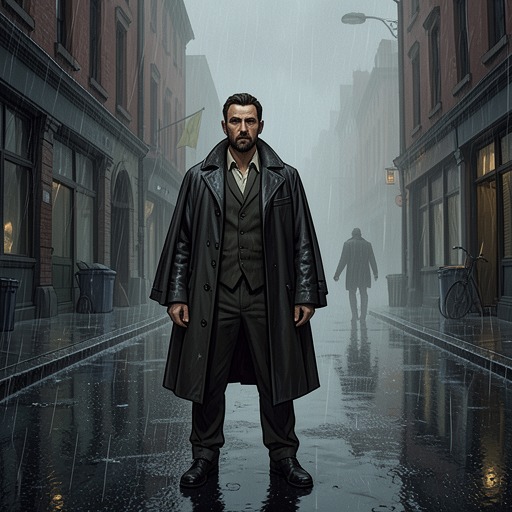
Shortly after the Civil War, cholera took Daniel’s mother. She was buried on Montjuic on Daniel’s fourth birthday, and his own recollection of the funeral narrowed to the rain and his unanswered question about whether heaven was crying. Six years later, he still felt her absence throughout the family home. At night he spoke to her in the darkness, recounting his daily life as though she could hear him; his father listened from the next room and wept quietly.
The limits of memory became unmistakable one June morning when Daniel woke in panic because he could no longer remember his mother’s face. His father held him and promised to remember for both of them. That answer makes remembrance an intimate, shared duty: Daniel’s lost image is not restored, but his father offers to carry it on his behalf. The scene also reverses the usual direction of inheritance. The parent becomes the custodian of a memory the child fears losing, while the child recognizes for the first time that his father is growing old.
Books provide another structure for what a person cannot keep unaided. Daniel grows up above his father’s bookshop on Calle Santa Ana, among rare editions and secondhand books. When he reads the novel he has chosen from the Cemetery of Forgotten Books, its story takes him through nested narratives and reflections, holding him until dawn. Later, he recalls the idea that a first book to reach a reader’s heart leaves images and echoes that accompany the reader through life. For Daniel, those formative pages are tied to the Cemetery itself: a place where forgotten books retain worlds and voices awaiting a reader.
Private Silence and the War’s Unspoken Past
Daniel’s father tries to shape what his son may remember. He explains that, before her death, Daniel’s mother made him promise never to speak to Daniel about the war or let him remember what had happened. He now doubts whether he was right to honor that promise. His hesitation establishes silence as a family inheritance: Daniel receives not a clear account of the past, but its gaps, restraints, and the knowledge that something has deliberately been kept from him.
The novel sets this domestic silence against a broader pattern of postwar forgetting. A later account describes war as feeding forgetfulness: people are pressed to treat what they witnessed and did as illusion, while survivors fall silent. The warning is not that every detail can be preserved, but that suppressed experience may return under another name when those able to testify are gone. In this context, the father’s promise reflects a private attempt to shield Daniel, while also showing how personal protection can reproduce the wider culture of silence.
The story gives memory material settings as well as spoken testimony. In the abandoned apartment Daniel enters, dust, decay, and apparent footprints register a past that has not simply disappeared, even though its inhabitants are absent. In the Aldaya mansion, Daniel and Bea discover a crypt containing two coffins: one for Penelope Aldaya and another, smaller one for her son David. Years later, Daniel returns to the mansion and finds that its former garden has become a car park, its library a boardroom, and the room where he and Bea conceived Julian a bathroom. These changes show how a place can survive while its meaning is overwritten; the old house remains, but its public use no longer acknowledges the histories held within it.
The Cemetery, the Crypt, and What Survives
Daniel’s decision to return a book to the Cemetery of Forgotten Books gives the theme a concrete form. He hides The Shadow of the Wind behind volumes on the disentailment of church property, between a 1901 yearbook of judicial minutiae from the civil courts of Gerona and novels by Juan Valera. The careful concealment protects the book, but leaving it among the Cemetery’s immense holdings also confronts Daniel with the scale of what may never be read. He imagines countless abandoned pages and worlds sinking out of view while the living world mistakes forgetting for wisdom.
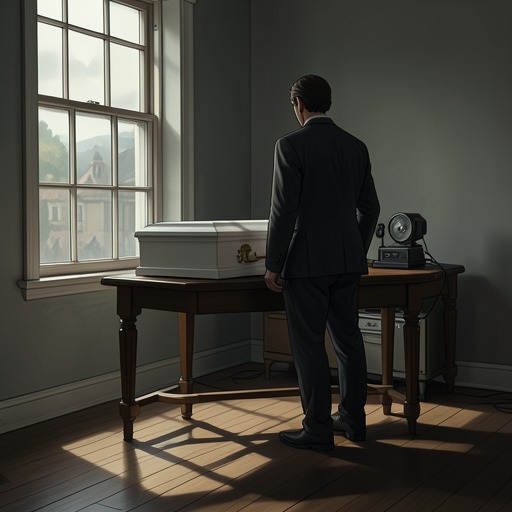
The crypt under the Aldaya mansion makes that loss bodily and familial without resolving it into abstraction. Daniel first finds the two white coffins and reads Penelope’s name and dates, 1902–1919. Later, Julian descends to the same chamber and sees Penelope and David named together, their dates showing that David died in 1919 as well. The paired graves expose a history that the mansion’s visible rooms and the family’s silence had concealed. Their discovery changes the meaning of the house: it is not merely an abandoned setting but a repository of a family catastrophe whose evidence has endured underground.
The novel places such discoveries beside the disappearance of public memory after the war. When the fighting ends, silence and shame settle over Barcelona, and survivors understand that those who died cannot tell their own stories. The result is an uneasy contrast: physical traces may persist—in a hidden book, a grave inscription, an altered building—while the explanations that would connect them are suppressed or lost. Remembering therefore requires attention to fragments and the willingness to make their testimony audible.
Testimony, Reading, and the Work of Remembering
Nuria Monfort’s memoir turns remembrance into a message deliberately passed to Daniel. Writing near the end of her life, she asks her father to ensure that the pages reach him if anything happens to her. She knows that Fumero has watched her for years and expects that he may kill her; she also fears that Daniel and his friends will be led to Julian. Her account is consequently both a record of what happened and an appeal to a future reader who may still be able to act.
Nuria asks Daniel to remember her, even secretly, and invokes Julian’s conviction that people remain alive as long as they are remembered. Her letter shifts the theme from the recovery of facts to the ethics of receiving another person’s story. Daniel is not simply given information about the past; he is made responsible for carrying forward a voice that might otherwise be silenced. The written account crosses the boundary between private memory and another generation’s knowledge, while preserving the writer’s fear, hope, and request for forgiveness.
The closing return of The Angel of Mist gives that transmission a final, material echo. After Daniel visits the restored Aldaya mansion, a parcel bearing a Paris postmark arrives at the bookshop. Inside is a novel by Boris Laurent, and on its first page Daniel recognizes the handwriting of the pen he once longed for as a child. The dedication thanks him for giving the writer back his voice and pen, and thanks Beatriz for helping restore their lives. A book, a familiar hand, and a dedication link the child who feared losing his mother’s face to the adult entrusted with other people’s memories. Across the novel, forgetting threatens through grief, war, concealment, and redevelopment; reading and testimony offer no return to an untouched past, but they allow the people within it to remain present.